DynamicDrive
- 4.4
- Rating
- 100.00K
- Installs
- Free
- Price

 Analysis by App-foxy
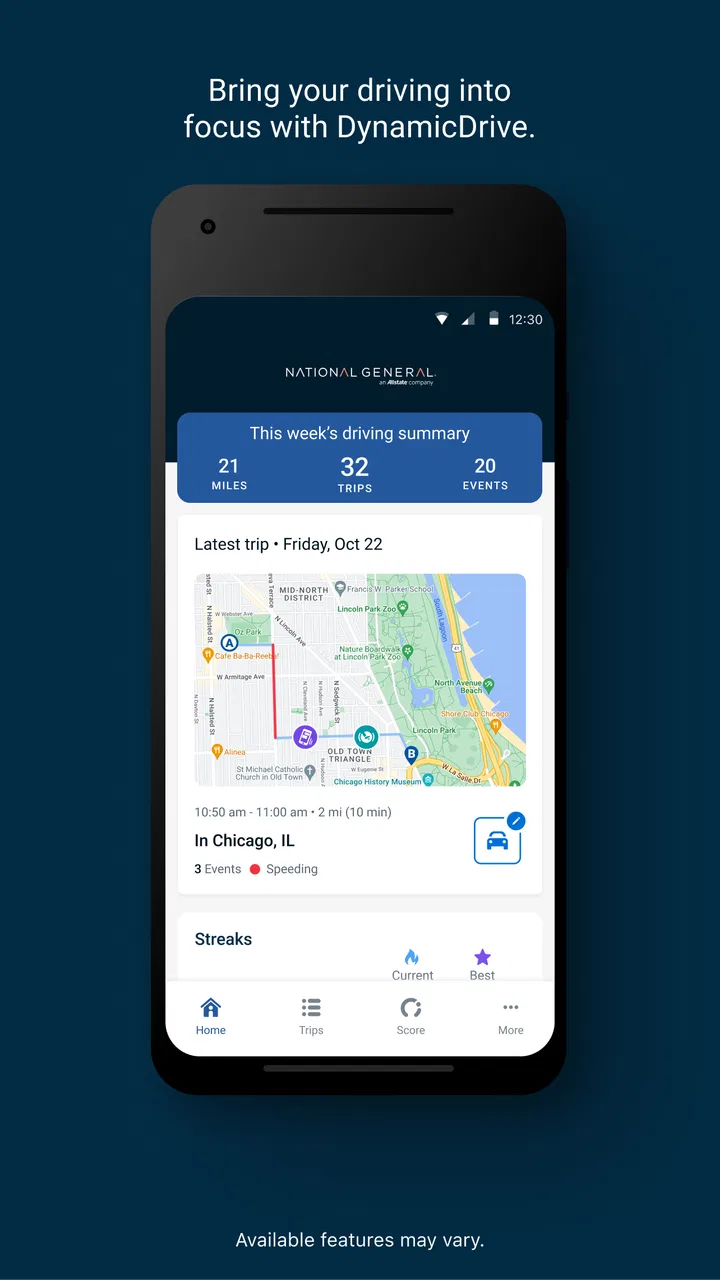
DynamicDrive is the kind of driving-monitoring app I would try when I wanted feedback about my habits behind the wheel without adding another physical gadget to the car. Developed by National General Insurance, it sits in the Auto & Vehicles category and focuses on observing driving behavior with the goal of encouraging safer choices and helping eligible users save. I found that purpose more interesting than a simple trip log because it turns ordinary commutes into opportunities to notice patterns.
The app is free, rated for Everyone, and has attracted over one hundred thousand installs. Its average rating is 4.2 from around six thousand ratings, which suggests that many drivers find the concept useful while leaving room for the occasional rough edge. It was released on November 1, 2024, and the current version is 3.0.0. Those details matter because a relatively recent app can feel modern while still developing its polish through later updates.
How DynamicDrive feels during everyday driving
My first impression is that DynamicDrive makes the most sense as a background companion rather than an app I open constantly. The value comes from letting it observe trips and then using that information to think about driving choices afterward. That changes how I judge its speed. I do not need an instant, game-like response every second; I need it to start reliably, stay out of my way, and present useful feedback when I am ready to review it.
You May Also Like

 Google Keep - Notes and lists
Google Keep’s Quiet Growth Shows the Appeal of Simpler Notes
As mobile work gets busier, Google Keep keeps winning a simple contest: capture a thought quickly, find it later, and get on with the day.

 Blood Strike: 2.5 Anniversary
Blood Strike’s Loadouts Turn Every Drop Into a Tactical Gamble
A close look at Blood Strike’s custom loadouts: how fast access to signature weapons reshapes its battle royale rhythm, rewards preparation, and narrows the gap between fights.

 Pandora - Music & Podcasts
Pandora’s Music Is Easy to Start, but Harder to Recover
Pandora’s strength is its low-effort path from a seed to a station. Its weak spot is how much confidence it asks you to place in connection, setup, and quiet recovery.

 8 Ball Pool
 Is Built on Rivalries, Rematches, and Routine
A close look at the rivalries, rematches, shared routines, and unanswered safety questions that turn a quick pool match into a persistent mobile community.

 Samsung Music
’s Quiet Strength Is Playing What You Already Own
Its reach comes less from spectacle than from dependable access to a personal library. That simplicity is both the app’s strongest retention engine and its ceiling.

 AccuWeather: Weather Radar
AccuWeather Review: A Quick, Clear Forecast for Everyday Decisions
For everyday plans, the best forecast is the one you can understand quickly. AccuWeather makes rain timing, radar, and local conditions easy to act on, with a few trade-offs.
More From Our News Desk



For a short drive to a supermarket, the experience should be judged differently from a long commute. A brief trip gives the app less context and may not reveal much about a driver's regular habits. A repeated route, on the other hand, gives me a better chance to notice whether I brake abruptly at a particular junction, accelerate too quickly when traffic clears, or become less smooth when I am running late. The practical benefit is not a single score but the ability to connect a result with a real situation.
I would not expect DynamicDrive to transform a driver after one journey. Its usefulness grows when I treat it as a feedback loop: drive normally, review what happened, choose one behavior to improve, and then check whether the next few trips feel different. That approach is more realistic than trying to chase a perfect result on every outing, especially because traffic, weather, road design, and passengers can all affect a drive.
What happens when the app is used heavily
The most demanding period is likely to be a day filled with several drives rather than one isolated journey. A person who commutes, makes deliveries, collects children, or travels between appointments may leave little time between trips. In that situation, the important question is whether the app remains convenient enough to keep using. I would build a simple routine around it: check that it is ready before leaving, avoid interacting with the phone while moving, and review the information only after parking.
That workflow also prevents a common mistake. An app designed to encourage safer driving should never become a reason to touch the screen while the car is moving. DynamicDrive is most useful when it stays in the background and the driver treats post-trip review as the main interaction. If I needed turn-by-turn directions, I would use a dedicated navigation tool for that job and leave this app to its monitoring role.
Heavy use can also expose practical friction. If I make many short stops, I may have to remember whether a new trip has begun or whether the app is ready to record the next one. I would not assume that every journey will be equally informative. A parking-lot maneuver, a very short errand, or a trip interrupted by unusual road conditions may not represent my normal driving. The sensible response is to look for trends across several ordinary drives instead of reacting strongly to one result.
There is a useful trade-off here. The more consistently I use a monitoring app, the more representative the feedback can become, but the more important it is that the process remains effortless. If starting a trip, checking a status, or reviewing results becomes a chore, I am less likely to continue. DynamicDrive appeals most to drivers willing to establish a small habit rather than people looking for an occasional novelty.
Stability and recovering from an interrupted trip
Reliability matters more to me than visual polish in this category. A driving monitor has to fit around unpredictable real life: a phone call, a stop at a fuel station, a low battery warning, a change in vehicles, or an accidental app closure. I would judge DynamicDrive by how confidently I can return to my routine after one of those interruptions, not merely by how attractive its screens look.
My practical advice is to give the app a short settling-in period. Use it on familiar routes, check the results after parking, and see whether the recorded feedback matches what happened on the road. If something looks unusual, I would not immediately blame my driving or the application. I would repeat the route under normal conditions and compare the broader pattern. That is a more dependable way to interpret a behavior-monitoring tool.
There is also a privacy-and-attention consideration, even without turning it into a technical checklist. Any app that observes driving behavior deserves deliberate setup and regular review of how it fits into my phone habits. I would avoid installing it on a device that is already struggling with everyday essentials, and I would make sure I understand what I am agreeing to before relying on it for savings-related expectations. The app's purpose is attractive, but the decision to use it should still be personal.
Recovery is especially important for people who drive across changing conditions. A trip may be interrupted by entering a garage, losing connectivity, switching from one vehicle to another, or restarting the phone. I would not treat a single missing or incomplete drive as a reason to abandon the app. Instead, I would check whether normal use resumes on the next journey. If interruptions happen repeatedly, however, the monitoring benefit becomes less convincing because the record no longer reflects my regular driving.
Phone limits and compatibility
DynamicDrive requires Android 10 or later, so compatibility is not universal across older phones. That is a straightforward limitation for anyone keeping an aging device, and it is worth checking before planning around the app. A phone that cannot meet the minimum operating-system requirement is not a good candidate, regardless of how appealing the driving feedback sounds.
Even on a compatible phone, the device itself can influence the experience. A weak battery, limited free storage, an overloaded background-app setup, or an unreliable vehicle mount can make any driving companion feel less dependable. I would begin with a charged phone, a secure position that does not tempt me to handle it, and enough time to test the routine on a normal trip. Those simple preparations do more for a smooth experience than repeatedly opening the app while driving.
Resource demands are another reason I would avoid judging the app after only one brief session. Background monitoring can feel more noticeable on an older or heavily used phone than on a newer one, but the available facts do not justify promising a particular battery impact or speed. My expectation would be modest: DynamicDrive should be treated as an additional background task, and drivers who already finish the day with very little battery should plan accordingly.
The Android requirement also shapes who should skip it. If I use an older handset that cannot run the current version, upgrading solely for this app would be hard to justify unless the potential savings and safer-driving feedback are especially important to me. A driver who wants a broad vehicle-maintenance tool, fuel-price finder, or navigation package may be better served by a different Auto & Vehicles app, because DynamicDrive has a narrower purpose.
Who gets the most from the monitoring approach
I see the strongest fit for a driver who wants a gentle accountability system. Newer drivers may appreciate a structured way to think about smooth acceleration and braking. Experienced drivers can benefit too, particularly if they are trying to replace rushed habits developed during stressful commutes. Families may also find it useful as a conversation starter, provided the feedback is discussed constructively rather than used to criticize every imperfect trip.
One realistic example is a commuter who leaves home late several mornings in a row. The driver may believe the problem is simply traffic, but reviewing repeated trips could encourage a closer look at the moments that feel rushed: hard acceleration after a light, late braking near a familiar turn, or unnecessary lane changes. The app cannot remove congestion, but it can help the driver choose one calmer behavior to practice. That is a more achievable goal than expecting a score to solve the entire commute.
Another useful scenario is preparing for a savings decision. Because the app's stated purpose connects safer driving with saving, I would use it to understand whether I am comfortable with that exchange before depending on it financially. I would not assume that installing it automatically guarantees a discount. Instead, I would regard the monitoring as a way to participate in a driving-based program and then review the applicable terms carefully. This distinction prevents disappointment and keeps the app's role clear.
DynamicDrive is less suitable for someone who dislikes behavior tracking, rarely drives, changes phones frequently, or expects a full vehicle-management suite. It is also not the right choice for a driver who wants live navigation, roadside assistance, maintenance reminders, or detailed mechanical diagnostics in the same place. Those are different needs. A dedicated app can be better when the main task is route planning, while a vehicle-service app may be more useful for maintenance records.
Where it differs from ordinary alternatives
Traditional alternatives usually depend on self-reporting or separate equipment. I might keep notes about my trips, use a paper checklist, or install a physical telematics device. Notes are flexible but subjective; I tend to remember dramatic moments and forget the ordinary ones. A dedicated device may offer a more specialized setup, but it adds hardware, installation, and another object to manage. DynamicDrive's appeal is the possibility of making the phone I already carry part of the process.
That convenience comes with a compromise. A phone-based approach is tied more closely to the condition and habits of the handset. If I forget the phone, change vehicles, run out of power, or use it in a way that interrupts monitoring, the record may be less complete. A physical solution can feel more automatic in some situations, while a simple notebook can be preferable for a driver who wants complete control and no background observation.
The app also differs from a basic navigation tool because its purpose is reflective rather than directional. Navigation tells me where to go; DynamicDrive is intended to help me consider how I drive. I would use both when appropriate, but I would keep their roles separate. Trying to make one replace the other would create the wrong expectations and could encourage unnecessary interaction with the phone on the road.
For insurance customers interested in a driving-based savings opportunity, the connection to National General Insurance may make the app more relevant than a generic habit tracker. For everyone else, the value depends on whether the feedback itself is worth adopting. I would not choose it merely because it is free. I would choose it if I genuinely wanted a continuing prompt to drive more smoothly and was comfortable with the program's conditions.
Small habits that make the review data more useful
I would start by using the app during ordinary trips rather than deliberately driving unusually carefully for a single test. A normal week gives a more honest picture. I would also separate unusual events from regular habits: roadworks, a sudden obstruction, an emergency maneuver, or a passenger distraction should not automatically define my overall driving style.
A second useful habit is to focus on one change at a time. If I try to alter acceleration, braking, following distance, and every other behavior simultaneously, I will not know what helped. I would choose the behavior that appears most often, practice it on familiar roads, and then review whether the next group of trips feels calmer. This turns the app from a passive scorecard into a practical coaching prompt.
Third, I would review feedback only when I am parked and not emotionally rushed. Looking at a result immediately after a stressful drive can lead me to dismiss it or overreact. A calmer review makes it easier to ask whether the result reflects a repeatable habit, a road-specific issue, or an unusual event. That distinction is one of the app's less obvious benefits: it can encourage better self-observation, not just better driving technique.
I would also keep expectations realistic around savings. The app may support a program designed to reward safer behavior, but the presence of monitoring is not the same as a guaranteed financial outcome. Anyone joining for that reason should read the relevant insurance terms and decide whether the possible benefit is worth the tracking arrangement. The free price removes an upfront purchase barrier, but it does not eliminate the need to understand the commitment.
My performance verdict
After weighing speed expectations, demanding daily use, reliability, and device constraints, I see DynamicDrive as a focused tool rather than an all-purpose driving app. Its strongest quality is the clear connection between routine journeys and personal feedback. I like that it can fit into a driver's existing phone setup instead of requiring a separate gadget, and I think the approach has real potential for people who respond well to gradual accountability.
Its limitations are equally clear. The experience depends on consistent phone use, a compatible device, and a willingness to review behavior over time. It is not a replacement for navigation, mechanical care, or attentive driving. It also should not be treated as a promise of savings simply because the app is installed. Drivers who want instant information during a trip may find its reflective purpose less satisfying, while privacy-conscious users may prefer a manual alternative.
For me, the best reason to try it is not the novelty of seeing a driving result. It is the chance to turn vague impressions—“I brake too late” or “my commute makes me impatient”—into a repeatable review habit. I would install it on a compatible Android phone, test it across familiar and varied routes, and decide after several normal drives whether the feedback changes anything I do. That is a fair test, and it avoids judging the app on one unusual journey.
My recommendation is cautious but positive: DynamicDrive is worth considering for drivers who want safer-driving feedback and may value a savings-oriented program, especially if they are comfortable with phone-based monitoring. I would skip it if I needed navigation, vehicle diagnostics, or a completely hands-off solution. As a free Auto & Vehicles app from National General Insurance, it has a specific job, and it performs best when I let it do that job without expecting it to become the entire driving toolkit.
In short, DynamicDrive is most convincing as a quiet long-term companion. Its success depends less on dramatic speed than on steady, dependable use and honest interpretation of the feedback. If I am prepared to build that small habit, the app can give everyday driving more structure. If I am not, a simpler manual method—or a different type of driving app—will probably serve me better.
FAQs for DynamicDrive
01What is DynamicDrive and what does it offer?
DynamicDrive is a cutting-edge navigation app designed to optimize your driving experience. It provides real-time traffic updates, route optimization, and voice-guided navigation. The app integrates with various map services to offer accurate and up-to-date information, ensuring you reach your destination efficiently and safely.
02Is DynamicDrive available for free, or does it require a subscription?
DynamicDrive offers a free version with basic features, such as standard navigation and traffic updates. However, to access premium features like advanced route planning and ad-free experience, users can opt for a subscription plan. The app provides flexible pricing options to cater to different user needs.
03How does DynamicDrive handle data privacy and user information?
DynamicDrive prioritizes user privacy by employing robust encryption protocols to protect data. The app only collects necessary information to enhance user experience, and it offers customizable privacy settings. Users can control data sharing preferences and access a detailed privacy policy within the app.
04What devices and operating systems are compatible with DynamicDrive?
DynamicDrive is compatible with both Android and iOS devices. It supports a wide range of smartphones and tablets, ensuring a seamless experience across different platforms. Users should ensure their device meets the minimum system requirements for optimal performance and updates.
05How can users report issues or provide feedback about DynamicDrive?
Users can easily report issues or provide feedback through the app's built-in support feature. By navigating to the 'Help & Support' section, users can submit queries, report bugs, or suggest improvements. The DynamicDrive support team is responsive and committed to enhancing user experience through timely updates.
Pros
- User-friendly interface for easy navigation.
- Offers real-time traffic updates.
- Customizable notifications for alerts.
- Integrates with major map services.
- Supports offline maps for remote areas.
Cons
- High battery usage during navigation.
- Some features require in-app purchases.
- Occasional lag in loading map data.
- Limited language support for non-English speakers.
- Requires a stable internet connection for updates.

DynamicDrive
Gallery